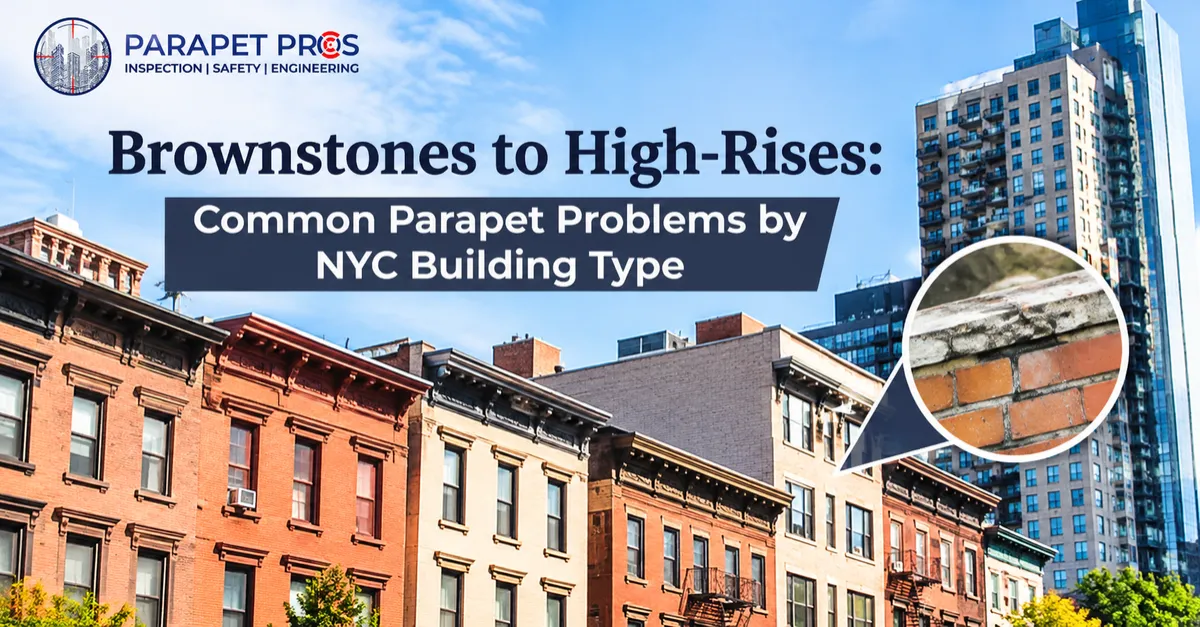
Brownstones to High-Rises: Common Parapet Problems by NYC Building Type
Every NYC building with a street-facing parapet needs the same annual inspection under Local Law 126. But a 120-year-old brownstone and a 1960s apartment tower fail in very different ways.
Knowing your building type tells you where problems usually start, what your inspector will focus on, and what repairs to budget for. Here's what to watch for in the five most common types of NYC buildings.
Brownstones and Rowhouses
Brownstone is a soft sandstone that absorbs water and wears away in layers. Many rowhouse parapets are low walls of brick or brownstone topped with stone coping.
Watch for: flaking or peeling stone faces, crumbling mortar under the coping, and old patch repairs that have come loose. The rule exempts only detached one- and two-family homes, so an attached brownstone with a street-facing parapet needs an inspection even if it's a single-family house.
Walk-Up Tenements
The classic five- and six-storey walk-up often has a decorative sheet-metal cornice fixed to the top of a brick parapet. That metal is thin, and it's attached with iron brackets and anchors that rust over time.
Watch for: rust stains, sagging or separated cornice sections, and loose anchors. A cornice that sits on a parapet must be inspected along with the parapet itself.
Pre-War Elevator Buildings
Buildings from roughly 1900 to 1940 often feature ornate parapets with terra cotta, carved stone and balustrades. They look beautiful but have many joints and hidden steel supports where water can collect.
Watch for: cracked or loose terra cotta pieces, rust bleeding through masonry, and gaps in balustrade joints. Rusting steel inside the wall expands and can crack masonry from within.
Post-War Apartment Buildings
Many 1950s to 1970s buildings have plain brick parapets built as a thin outer layer over a structural frame. Their weak points are usually the steel shelf angles and flashing that hold back water.
Watch for: horizontal cracks along a line of brick, bulging or bowing sections, and brick displaced near the roof line. These often signal corroding steel or failed flashing.
Modern Buildings
Newer buildings may use metal coping, glass guardrails or panel systems instead of solid masonry. The parapet itself may be sound, but it often carries a lot of rooftop equipment.
Watch for: loose metal coping, failed sealant joints, and antennas, railings, signs or ladders attached to the parapet. The rule requires these attachments to be stable and secure.
Quick Reference: Parapet Problems by Building Type
Building type | Typical era | Main weak point | Key warning sign |
Brownstone / rowhouse | 1850s–1900s | Soft stone and coping mortar | Flaking stone faces |
Walk-up tenement | 1880s–1920s | Sheet-metal cornice anchors | Rust stains, sagging cornice |
Pre-war elevator building | 1900s–1940s | Terra cotta and hidden steel | Cracked ornament, rust bleeding |
Post-war apartment building | 1950s–1970s | Shelf angles and flashing | Horizontal cracks, bulging brick |
Modern building | 1980s–today | Coping, sealant and attachments | Loose coping or equipment |
Whatever your building type, the annual inspection must cover the whole parapet and everything attached to it, under 1 RCNY §103-15.
Inspections Tailored to Your Building
Parapet Pros inspects parapets on every kind of NYC building, from brownstones to high-rises, and knows where each type tends to fail. Book your 2026 inspection before the December 31 deadline: call 718-482-8341, email admin@parapetpros.com, or schedule online.
